
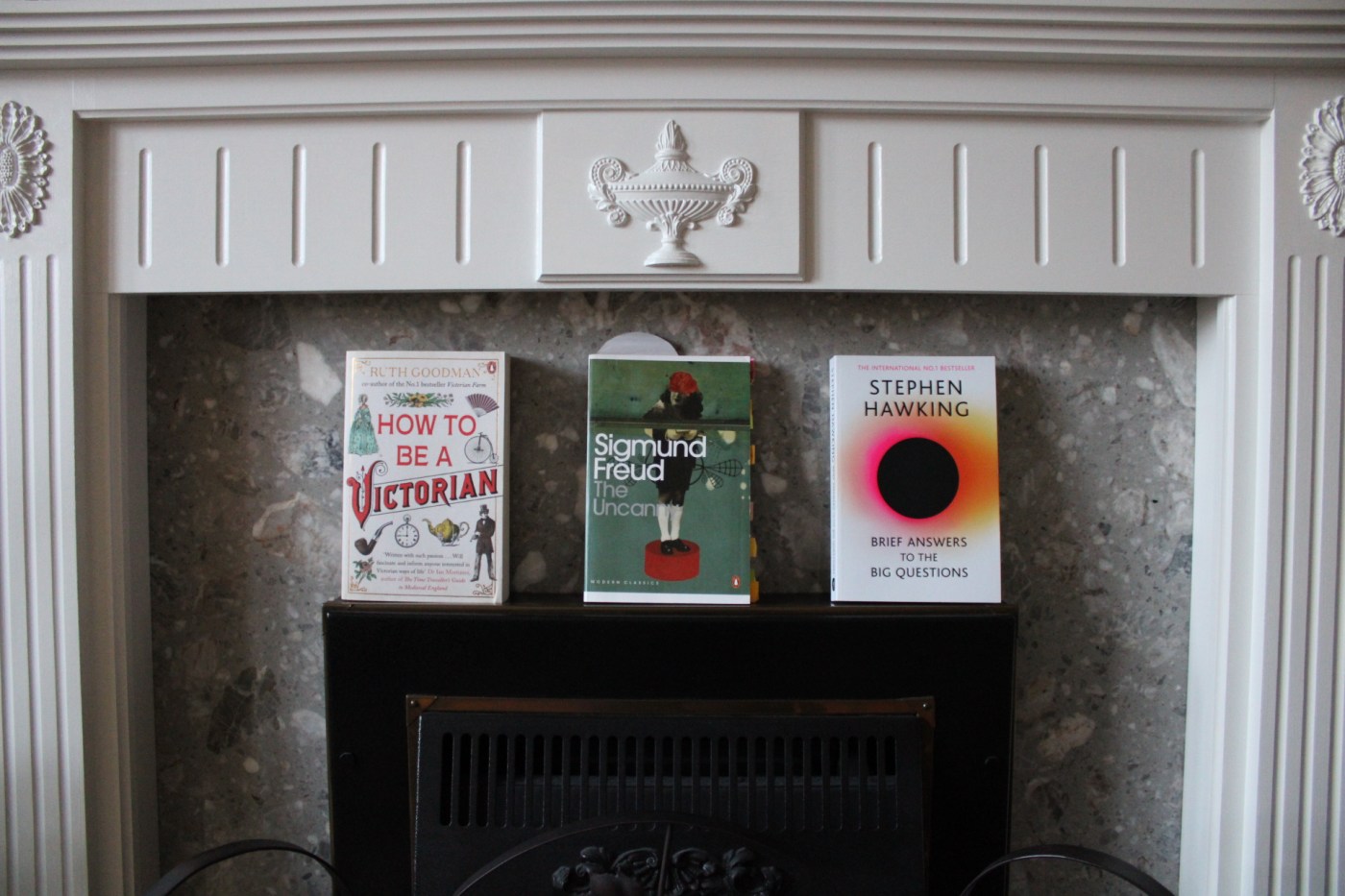
Welcome to the second article in my ‘Reading Delights’ series! This time I’m sharing my thoughts on some non-fiction: historian Ruth Goodman’s How To Be A Victorian, Sigmund Freud’s The Uncanny and Professor Stephen Hawking’s Brief Answers To The Big Questions.
Ruth Goodman: How To Be A Victorian
I’m going to preface this by saying that I am a huge fan of Ruth Goodman. I find her approach to history to be wonderful and fully immersive. That might be why I had her voice in my head while reading this book (I really hope that isn’t weird!). I’ve always had a fascination with the Victorians, from a love of steam trains and epic engineering achievements, to gothic literature and corsets. I love this book, because it explores the ‘normal’ everyday life of the average Victorian, from the lower to the upper classes. Now I should mention – the term Victorian in reference to the historical period covers a significant number of years (1837-1901) and does not fully reflect all aspects of life and developments that occurred. What I’m saying is, I’m using the term in a general sense fully aware that it is a generalisation of this time period in respect to social, economic, political and technological changes.
Now, back to the point, the theatrical aspect of nineteenth-century history is wonderful but it can make it hard to relate to from an individual perspective. Ruth’s work breaks down the barrier providing a look at the more intimate aspects of everyday life. Written over the span of a day – from getting up in the morning to going to bed, it’s non-fiction but reads well with a story like quality. If you’re not keen on non-fiction but enjoy history, this book is a great amalgamation of the two.
Sigmund Freud: The Uncanny
I first discovered this work during the years of my undergraduate studies at the University of Chester. Exploring eerie ideas of doppelgängers, death and the seemingly unexplainable, I immediately found the theory fascinating. This book is, I think, accessible and easy to read even if you’re not someone who has read many literary theories before.
One thing I would like to mention, is that like all things, Freud’s theory is not perfect and does carry some problematic elements. For example, the parallels between ‘uncanny’ events and outdated heteronormative, patriarchal, misogynistic values are something to be aware of. The theory of the uncanny does not revolve around discriminative ideas but has been applied in this way with some examples being highly questionable. That being said, applying a pinch of salt and being aware of this, I still think the text is interesting and can add some valuable knowledge.
Website: https://www.freud.org.uk/
Professor Stephen Hawking: Brief Answers To The Big Questions
I am not a theoretical physicist, I’m just getting that in early, but I find space and explorations of the universe (or possible universes) incredible – it fills me with an amazing sense of awe. This is an accessible text, on the whole. There were occasions when reading this that I did get a little bit lost but I would blame that on my lack of understanding of theoretical physics. It is very readable in terms of how it’s written and the organisation of chapters. It feels more personal, with aspects of Stephen’s life included amongst the science, and this gives an extra dimension. Having his personal thoughts placed in the explanations does help to see how Stephen and his fellow scientists reached their conclusions.
One thing to add, the most recent edition of this book (the paperback was released in 2020) also contains some lovely tributes to the Professor from his family, colleagues and actor Eddie Redmayne who portrayed Stephen in the 2014 film The Theory of Everything.
Website: https://www.hawking.org.uk/

Thank you for sharing!
LikeLiked by 1 person
Glad you enjoyed it! :)
LikeLike